Uman
Power system networks are undergoing a rapid transformation due to the increasing integration of renewable energy sources (RES), decentralization of electricity generation, and the gradual retirement of conventional synchronous generators. The overarching objective of Uman is to investigate the different schemes that can be developed to enable TSO-DSO coordination.
AI.grids
Under the aegis of DG Energy AI.grids aims at building the first Pan-European AI foundation model for power grid operations through a collaborative ecosystem of system operators, research organisations, and technology providers. Inspired by advances in large-scale AI models in other domains, the initiative will develop a shared model capable of learning from diverse grid datasets and supporting multiple operational applications, ranging from forecasting and congestion management to planning and asset monitoring.
BiGER
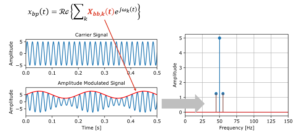
BiGER is about bridging EMT and RMS approaches for dynamic simulation of IBR-dominated power systems: can one complement the quick RMS approach and how? for which use cases? How to cope with EMT data & computation time requirements beyond the grid operator’s boundaries? Is there an intermediate/third path?
uSCC
uSCC aims at inventing a new quasi-static short-circuit current simulator, embedding adequate modelling of IBRs, FACTS, HVDC and load. This new approach (simulator, assumptions and validation) could replace the existing one for equipment dimensioning during the planning phase and push the update of the current standard.
PSSIx
PSSIx will propose and develop new stability indexes for power systems with increased penetration of inverter-based resources. Depending on the type of stability, the index can determine the stability of the grid or designate the area or the devices that are weakening the grid.

Path2GFM
Path2GFM is an extension of LF Energy GridFM project, integrating the LF Energy PowSyBl & Dynawo packages to enable power system synthetic data generation.
D-GITT
D-GITT (Detailed Grid Inner Topology Timeseries) is a chapter of OpenSynth (LF Energy) dedicated to power grid descriptive data, including both real and synthetic datasets and the tools to generate them.

DyPSOS
DyPSOS (Dynamic Power System model Optimisation and Surrogates) develops an open-source automated framework that bridges the gap between generic and black-box models, without requiring access to proprietary model internals.
JoDyMoTePS
JoDyMoTePS (Joint Dynamic Modelling & Testing of Power Systems) is an open-source framework enabling TSOs, DSOs, equipment manufacturers and renewable energy developers to share privacy-preserving models of sub-parts of the European interconnected grid and to perform realistic dynamic co-simulations — without any party exposing sensitive data.
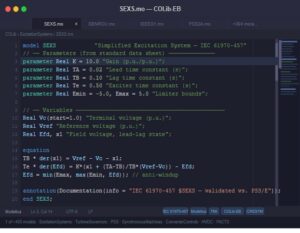
COLib-EB
COLib-EB (COLib — Equation-Based) extends CRESYM’s COLib library with a complete equation-based representation layer for all ~400 models defined in IEC 61970-457, making COLib the reference implementation that unites model data, mathematical equations and executable behaviour under one open-source framework.
COLib-SOGL
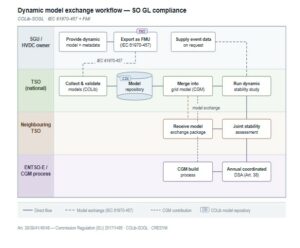
COLib-SOGL provides TSOs with the technical architecture, processes and simulation methodology needed to comply with their SO GL obligations for dynamic data exchange and stability assessment — covering conventional equipment, HVDC systems, SGUs and FACTS devices.
CSL-TD (ReLife)
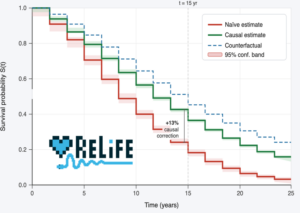
CSL-TD (Causal Survival Learning with Time-Dependent covariates) develops a rigorous methodological framework for causal survival analysis applied to industrial assets, enabling operators to quantify the true effect of controllable variables — maintenance strategies, operational decisions — on asset time-to-failure, using observational data alone.
BatMan
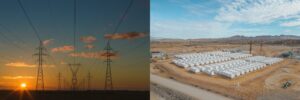
BatMan investigates how BESS can provide flexibilities at transmission level, from D-1 to real-time, in particular for managing grid congestion.

DC-BL
DC‑BL explores PowSyBl as a common, open-source and extensible simulation framework for AC-DC models with multi-terminals DC subnetworks. PowSyBl (Power System Blocks) natively supports CIM/CGMES formats, enabling consistent and interoperable data exchange between TSOs across Europe.

MESTo
MESTo (Multi-Energy System economics & Tools) is a Doctoral Network (“DoNet”) involving Cresym members & observers interested in multi-energy systems planning, flexibility, economic & related topics. It started with both MuESSLi & PlaneTerr projects.
Inter-oPEn
Complementary to other related research (interOPERA, HVDC-wise, etc.), Inter-oPEn investigates how openness (“whiteboxes” especially) can unlock interoperability issues of power electronic (PE) devices in power systems, marrying both technological and legal aspects. The project is sponsored by EC’s Horizon Europe program
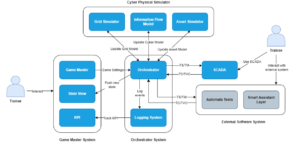
TraiSim (TWINEU pilot 8)
TraiSim complements the Horizon EuropeTWINEU project and specifically its Pilot n°8, both forming parts of a unified initiative, developping an operator training simulator environment.

MuESSLi
MuESSLi aims at “smart-linking” simulation tools to perform cross-sector, actually scalable, simulations and enable the optimal development and operation of an holistic “energy system” (power, heat, transportation, etc.) with electricity and hydrogen as main carriers.
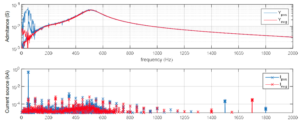
Harmony
Harmony is a toolkit for easy harmonic analyses of (local EMT), to assess multi-terminal HVDC power systems, TSO-DSO interface, controller interoperability and HVDC protection.
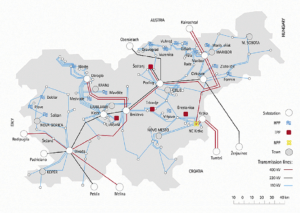
LaRISA – Large Res Integration Stability Analysis
The Slovenian network will experience in the next 10 years a high growth of electricity demand, decreasing inertia due to an high level of RES penetration (40% in energy coverage), and an increasing level of cross border exchanges. Stability issues must be tackled in network planning exercise.